MR84 WIDTH DEPENDS ON THE PUBLISHED CONFIGURATIONUNIT / mm
RCL lists MR84 at 4 × 8 × 3 mm. NSK and EZO list open MR84 at 4 × 8 × 2 mm and MR84ZZ at 4 × 8 × 3 mm. Compare the exact row below before choosing the axial width.
Deep groove ball
MR84
MR84 is a deep groove ball designation documented on BearingIndex from 1 manufacturer publication. RCL’s MR84 row is 3 mm wide; the open MR84 entries from NSK and EZO are 2 mm wide. Their MR84ZZ entries are 3 mm wide. The directory dimensions below belong to RCL, not to every MR84 offer. The publishing works are in Zhejiang province, China. Every value below comes from that manufacturer’s own published material, with the date it was recorded.
An MR84 can be 2 mm or 3 mm wide. Start with the complete designation.
RCL publishes MR84 as 4 × 8 × 3 mm. NSK and EZO publish their open MR84 as 4 × 8 × 2 mm, and MR84ZZ as 4 × 8 × 3 mm. A quotation that says only “MR84, 4 × 8” leaves the axial width unresolved.
Compare the exact row, including its closure.
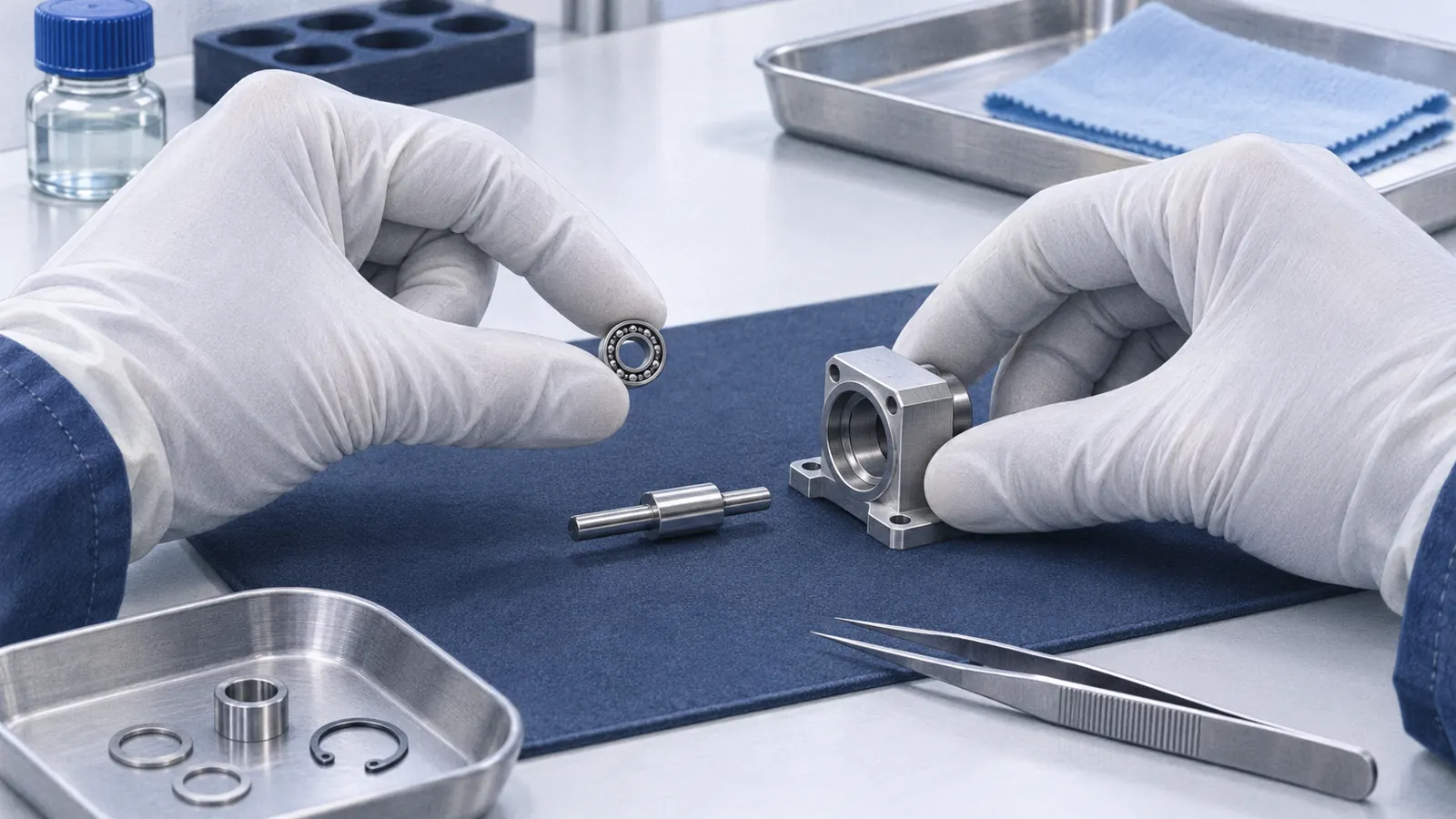
Illustration of miniature-bearing assembly; no specific maker or factory is depicted.
The RCL source [1] labels its 3 mm row simply MR84. It has no closure column. NSK’s current open row [2] explicitly says “Open (not sealed)”; its width is 2 mm. Keep those statements separate rather than renaming RCL’s product to make the rows agree.
Values were checked on 4 November 2026. RCL labels speed r/min; the other pages use min⁻¹. Both express revolutions per minute here. Load values remain in the sources’ newtons. In the directory table, RCL’s 395/140 N appear as 0.395/0.140 kN; its 0.56 g becomes 0.00056 kg by division by 1,000.
For a mechanism built around a 3 mm bearing, the 2 mm open row shortens the bearing’s axial span by 1 mm. A common bore and outside diameter do not preserve that stack length. Put the required width and closure on the order line; use the offered maker’s drawing to check the locating faces.
NSK’s current 435 N differs from its 2011 catalogue.
NSK catalogue E126h, 2011 B-11, printed pages 32–33 [6], lists MR84/MR84ZZ with dynamic 395 N and static 139 N. The current NSK online entries checked for this comparison list dynamic 435 N and static 139 N. The current figures in the table above come from those online entries; the older 395 N figure remains tied to its dated catalogue.
Neither inspected source explains the change. Retain the catalogue revision or current product sheet with the quotation so the design review uses the offered product’s documented rating. RCL and EZO still publish their own 395 N figures; NSK’s current 435 N does not replace either maker’s value.
EZO’s two rows list 67,000/79,000 min⁻¹, while the current NSK open row lists 56,000/67,000. NSK’s shielded row lists the grease value alone. Do not fill its blank oil entry from the open row. These catalogue speeds and ratings are inputs for reviewing the offered bearing, not the completed mechanism’s accepted operating speed or load.
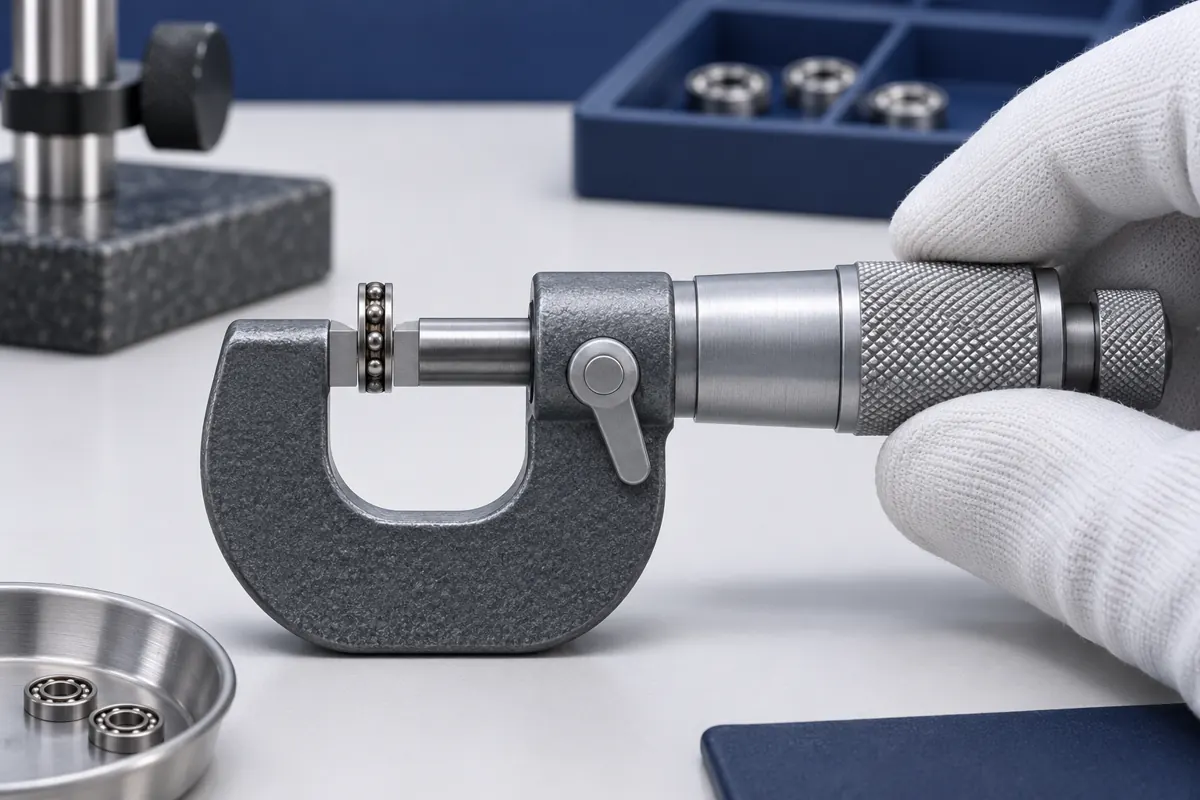
Illustration: measure the axial width separately from bore and outside diameter.
EZO’s open and shielded rows also differ at the shoulders.
The EZO detail pages publish more than the 1 mm width difference. Their abutment and fillet limits are:
EZO dimension, mm
MR84 [4]
MR84ZZ [5]
Shaft abutment dₐ, min–max (mm)
4.9–4.9
4.8–4.9
Housing abutment Dₐ, min–max (mm)
6.9–7.2
7.5–7.5
Maximum shaft and housing fillet radius (mm)
0.15
0.10
The housing-abutment ranges do not overlap. An EZO MR84ZZ drawing therefore requires a fresh check of the housing shoulder even though its bore and outside diameter match EZO MR84. Check the fillet against the selected row as well: the open row’s 0.15 mm allowance is not the shielded row’s 0.10 mm limit. These are EZO’s dimensions; RCL’s MR-series table does not supply corresponding shoulder limits.
For an RCL enquiry, include the required 3 mm axial span, a sketch of the locating shoulders and the required closure. Request an RCL drawing that resolves those features alongside its published MR84 row. If the offer changes to a 2 mm open bearing, revise the axial stack assessment before accepting it.
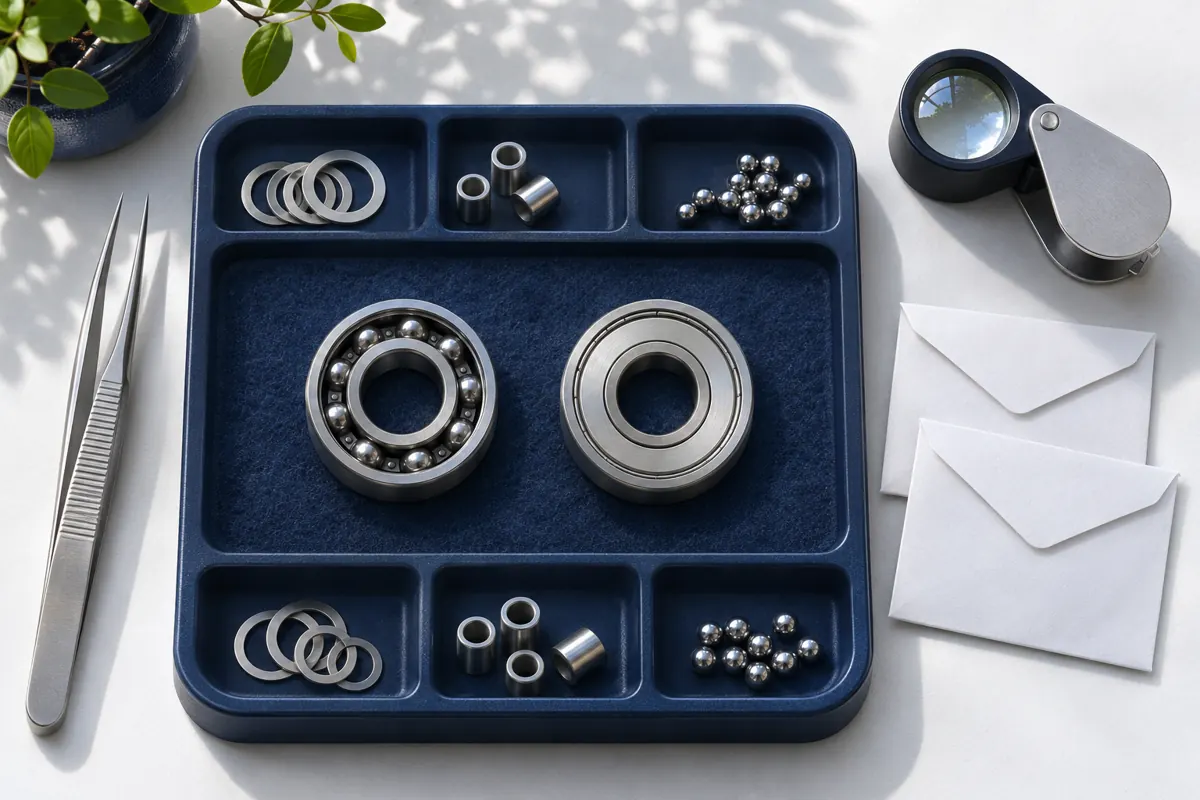
Illustrative open and shielded constructions; use the exact supplier drawing for dimensions.
What each manufacturer published.
Manufacturer
Dynamic load rating (kN)
Static load rating (kN)
Limiting speed — grease (rpm)
Limiting speed — oil (rpm)
Reference mass (kg)
Source recorded
RCL MR84 Current RCL MR-series row: MR84 / 4 / 8 / 3 mm / Cr395 / Cor140 N / grease56000 / oil67000 r/min / 0.56g. No closure column identifies this row as MR84ZZ.
0.395 RCL395 N, converted to0.395 kN. Current NSK open MR84 lists435 N; that value belongs to NSK.
A dash means the site’s recorded data does not provide that value; it is not proof that the manufacturer has never published it. Check the reviewed source notes for any newer findings. Dimensions every source agrees on are shown above rather than repeated per row.
RCL publishes 67/68/69, MR and 16 thin-section families and a harmonic-reducer bearing page. Its 67-series description explicitly asks designers to consider load capacity; encoder and flexible-bearing applications need different qualification inputs.
Published ranges: 67- and 68-series thin-wall bearings · 69-series ball bearings · 60-series ball bearings
131 designations documented here · 1 reviewed evidence record · source recorded 2026-10-08
Printed32–33, PDF18: older MR84/MR84ZZ dynamic395N/static139N. Edition date on back cover; does not supersede current online entries. Read and visually checked 2026-11-04.
Guide checked 2026-11-04. Manufacturer statements, technical background and BearingIndex purchasing suggestions are distinguished in the text. This is not application approval or firsthand product testing.
We use cookies and analytics to operate this website and measure visits. Form contents and private workspace pages are excluded from analytics. Privacy & cookies